
How to Implement the “Never Trust, Always Verify” Model for Corporate Networks in the Era of Hybrid Work, Cloud Computing, and Remote Employees
Cybersecurity has undergone a fundamental transformation over the past decade. The traditional approach of protecting a well-defined network perimeter with firewalls and antivirus software was once sufficient for organizations whose employees worked exclusively from corporate offices and accessed applications hosted on local servers. Today, however, businesses operate in a dramatically different environment.
Employees connect from home offices, airports, coffee shops, and client locations using laptops, smartphones, and personal devices. Critical business applications run in cloud platforms, Software-as-a-Service (SaaS) environments, and distributed infrastructures rather than within a single corporate data center. At the same time, cybercriminals have become increasingly sophisticated, exploiting stolen credentials, phishing attacks, ransomware, supply chain vulnerabilities, and insider threats to bypass conventional security controls.
In this new reality, trusting users simply because they are inside the corporate network is no longer a viable security strategy. Organizations require a model that continuously verifies every user, device, application, and request regardless of location.
This philosophy is known as Zero Trust.
Rather than assuming that internal traffic is inherently safe, Zero Trust operates on one simple but powerful principle:
Never trust. Always verify.
This article explores why perimeter-based security is becoming obsolete, how Zero Trust works, and how businesses can successfully implement this architecture to protect modern corporate networks in 2026.
Why Traditional Perimeter Security Is No Longer Enough
Historically, corporate security relied on the concept of a trusted internal network protected by a secure perimeter.
Security controls focused primarily on:
- Firewalls
- VPN gateways
- Antivirus software
- Network segmentation
- Email filtering
Once users successfully authenticated and entered the corporate network, they often gained broad access to internal systems.
This model assumed that threats originated outside the organization.
Today, that assumption is no longer valid.
Attackers increasingly exploit legitimate user accounts, compromised endpoints, third-party vendors, and cloud applications to move laterally inside corporate environments.
The Modern Threat Landscape
Organizations now face a broader range of cyber threats than ever before.
Common attack vectors include:
- Phishing campaigns
- Credential theft
- Ransomware
- Business Email Compromise (BEC)
- Insider threats
- Supply chain attacks
- Cloud misconfigurations
- API exploitation
- Malware
- Zero-day vulnerabilities
Many of these attacks begin with legitimate credentials rather than technical exploits.
As a result, identity has become the new security perimeter.
What Is Zero Trust?
Zero Trust is a cybersecurity architecture based on continuous verification rather than implicit trust.
Every request for access must be evaluated regardless of:
- User identity
- Device location
- Network connection
- Previous authentication
- Organizational role
Access is granted only after multiple security controls confirm that the request is legitimate.
Verification continues throughout each user session rather than ending after login.
The Core Principles of Zero Trust
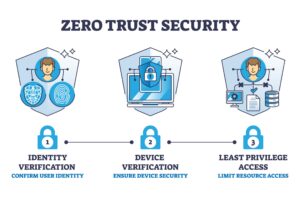
Although implementations vary, most Zero Trust strategies follow several foundational principles.
Never Trust by Default
No user or device is automatically trusted.
Internal traffic receives the same scrutiny as external requests.
Always Verify Identity
Every authentication attempt should be validated using multiple factors.
Verification typically considers:
- Username
- Password
- Multi-factor authentication
- Device identity
- User behavior
- Risk level
Identity verification becomes continuous rather than a one-time event.
Least Privilege Access
Users receive only the permissions necessary to perform their responsibilities.
This principle minimizes the impact of compromised accounts.
Examples include:
- Department-specific permissions
- Temporary administrative access
- Role-based authorization
- Just-in-time privilege elevation
Restricting unnecessary access significantly reduces organizational risk.
Continuous Authentication
Authentication should not end after login.
Modern security platforms continuously evaluate:
- User behavior
- Device health
- Geographic location
- Network changes
- Session activity
- Risk indicators
Suspicious behavior may trigger additional verification or automatic session termination.
Device Trust Matters
Zero Trust evaluates not only users but also the devices they use.
Security platforms assess whether devices meet organizational requirements.
Checks often include:
- Operating system updates
- Disk encryption
- Antivirus status
- Endpoint protection
- Device certificates
- Security policies
Unmanaged or compromised devices may receive limited or no access.
Microsegmentation Limits Lateral Movement
Traditional networks often allow attackers to move freely after gaining access.
Zero Trust introduces microsegmentation.
Instead of one large trusted network, infrastructure is divided into smaller isolated environments.
Examples include:
- Finance systems
- Human resources
- Development servers
- Customer databases
- Production infrastructure
Compromising one segment no longer grants unrestricted access to others.
Identity and Access Management (IAM)
Identity has become the foundation of enterprise security.
Modern Identity and Access Management solutions provide:
- Centralized authentication
- Single Sign-On (SSO)
- Multi-Factor Authentication (MFA)
- Role-based access control
- Identity lifecycle management
Strong identity governance reduces unauthorized access while improving administrative efficiency.
Multi-Factor Authentication Is Essential
Passwords alone no longer provide adequate protection.
Organizations should require MFA for:
- Email accounts
- VPN access
- Administrative portals
- Cloud services
- CRM platforms
- Financial systems
Authentication factors may include:
- Mobile authentication apps
- Hardware security keys
- Biometrics
- Push notifications
Even if passwords are compromised, additional verification significantly reduces the likelihood of unauthorized access.
Secure Remote Work
Hybrid and remote work have permanently changed corporate security requirements.
Employees frequently access business resources from:
- Home offices
- Hotels
- Airports
- Shared workspaces
- Mobile networks
Zero Trust protects these distributed environments by authenticating every request regardless of physical location.
Remote users receive the same security controls as employees inside corporate offices.
Protecting Cloud Applications
Modern businesses increasingly rely on cloud services.
Common platforms include:
- Productivity suites
- Customer relationship management
- Project management
- Accounting software
- Collaboration tools
Zero Trust extends consistent security policies across both on-premises and cloud resources.
Access decisions remain based on verified identity rather than network location.
Endpoint Detection and Response (EDR)
Endpoints represent one of the most common attack targets.
Modern Endpoint Detection and Response solutions continuously monitor devices for:
- Malware
- Suspicious behavior
- Unauthorized software
- Privilege escalation
- Ransomware activity
EDR platforms automatically isolate compromised devices before attacks spread throughout the organization.
Continuous Monitoring and Analytics
Zero Trust depends heavily on visibility.
Organizations should continuously monitor:
- Login activity
- Failed authentication attempts
- Device compliance
- Network traffic
- Privileged account usage
- Application access
- User behavior
Behavioral analytics help identify threats that traditional security tools might overlook.
Protecting Against Insider Threats
Not every cybersecurity incident originates from external attackers.
Employees, contractors, or partners may intentionally or accidentally expose sensitive information.
Zero Trust minimizes insider risk by enforcing:
- Least privilege
- Activity logging
- Access reviews
- Continuous verification
- Data protection policies
Trust becomes evidence-based rather than assumption-based.
Data-Centric Security
Modern organizations protect data itself rather than relying solely on network boundaries.
Important measures include:
- Encryption at rest
- Encryption in transit
- Data classification
- Access controls
- Digital rights management
- Backup encryption
Sensitive information remains protected regardless of where it resides.
Building a Zero Trust Strategy
Successful implementation occurs gradually rather than through a single deployment.
Typical phases include:
- Inventory users, devices, applications, and data.
- Classify critical assets.
- Implement centralized identity management.
- Enforce Multi-Factor Authentication.
- Apply least privilege access controls.
- Segment the network.
- Deploy endpoint protection.
- Continuously monitor activity.
- Automate incident response.
- Regularly review security policies.
A phased approach minimizes disruption while strengthening organizational resilience.
Common Challenges
Implementing Zero Trust requires careful planning.
Organizations may encounter challenges such as:
- Legacy applications
- Employee resistance
- Complex integrations
- Identity management modernization
- Policy development
- Staff training
- Budget considerations
Executive support and cross-department collaboration significantly improve implementation success.
Benefits of Zero Trust
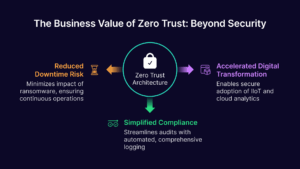
Organizations adopting Zero Trust typically experience:
- Reduced attack surface
- Improved ransomware protection
- Better visibility
- Stronger regulatory compliance
- Enhanced remote work security
- Faster threat detection
- Lower insider risk
- Improved business resilience
These benefits continue growing as digital transformation expands.
The Future of Zero Trust
Zero Trust continues evolving alongside artificial intelligence, cloud-native infrastructure, and increasingly sophisticated cyber threats.
Future developments will likely include:
- AI-assisted risk analysis
- Continuous adaptive authentication
- Passwordless identity systems
- Behavioral biometrics
- Automated policy enforcement
- Identity-centric networking
- Autonomous threat response
As organizations become more distributed, identity, verification, and contextual access decisions will replace traditional network boundaries as the primary foundations of enterprise security.
Conclusion
The era of trusting users simply because they are inside the corporate network has come to an end. Modern businesses operate across cloud platforms, remote work environments, mobile devices, and globally distributed infrastructures where traditional perimeter-based defenses are no longer sufficient. Zero Trust provides a modern security architecture built on continuous verification, least privilege access, strong identity management, and real-time monitoring.
By embracing the principle of “Never Trust, Always Verify,” organizations can significantly reduce cyber risk while enabling secure collaboration, hybrid work, and digital innovation. In 2026, Zero Trust is no longer an emerging concept—it has become a strategic cybersecurity framework that helps businesses protect their most valuable assets in an increasingly connected and unpredictable digital world.