How Data Loss Prevention Solutions Detect, Monitor, and Prevent Unauthorized Transfers of Confidential Business Information
In today’s digital economy, information has become one of the most valuable business assets. Product designs, source code, financial reports, customer databases, research documents, strategic plans, contracts, and proprietary algorithms often represent years of investment and millions of dollars in intellectual property. Unlike physical assets, however, digital information can be copied, shared, or stolen in seconds.
Modern organizations face growing risks from accidental data exposure, malicious insiders, compromised user accounts, ransomware groups, and increasingly sophisticated cybercriminals. The widespread adoption of cloud storage, remote work, mobile devices, and third-party collaboration has significantly expanded the number of channels through which confidential information can leave an organization.
Traditional cybersecurity tools such as firewalls, antivirus software, and endpoint protection remain essential, but they primarily focus on preventing unauthorized access to systems. They are often unable to stop authorized users from intentionally or unintentionally transferring sensitive data outside the organization.
This challenge has led many enterprises to implement Data Loss Prevention (DLP) systems—specialized security solutions designed to identify, monitor, and prevent the unauthorized movement of confidential information across networks, endpoints, cloud services, and email platforms.
This article explains how DLP systems work, why they have become essential for protecting intellectual property and trade secrets, and how organizations can successfully integrate them into a modern cybersecurity strategy.
Why Intellectual Property Requires Stronger Protection
For many businesses, intellectual property (IP) represents their greatest competitive advantage.
Examples include:
- Product designs
- Engineering documentation
- Source code
- Research data
- Manufacturing processes
- Customer databases
- Marketing strategies
- Financial forecasts
- Legal agreements
- Trade secrets
The theft or accidental disclosure of this information can result in financial losses, legal consequences, reputational damage, and the loss of market leadership.
Protecting these assets is therefore a strategic business priority, not merely an IT responsibility.
What Is Data Loss Prevention (DLP)?
Data Loss Prevention is a category of cybersecurity technologies that helps organizations prevent sensitive information from leaving approved environments without authorization.
Rather than focusing solely on network security, DLP protects the data itself.
A DLP solution continuously monitors how confidential information is:
- Created
- Accessed
- Modified
- Shared
- Stored
- Transferred
- Printed
- Deleted
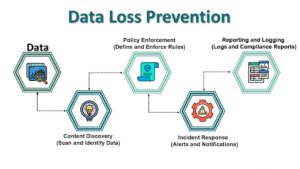
When suspicious activity is detected, predefined security policies determine whether the action should be allowed, blocked, encrypted, or reported.
Why Traditional Security Is Not Enough
Many security systems concentrate on preventing external attacks.
However, data breaches frequently involve:
- Human error
- Insider threats
- Compromised employee accounts
- Misconfigured cloud storage
- Unauthorized file sharing
- Lost devices
DLP addresses these risks by monitoring legitimate users and legitimate business processes without assuming that every authorized action is safe.
Types of Data Protected by DLP
Organizations can configure DLP policies to protect a wide range of sensitive information.
Examples include:
- Intellectual property
- Customer information
- Financial records
- Healthcare data
- Employee records
- Source code
- Legal documents
- Product roadmaps
- Contract negotiations
- Research and development files
Each organization defines protection policies based on its operational requirements and regulatory obligations.
How DLP Systems Identify Sensitive Information
Modern DLP platforms use multiple detection methods to recognize confidential content.
Content Inspection
Files are analyzed for sensitive information such as:
- Credit card numbers
- Bank account details
- National identification numbers
- Medical records
- Confidential keywords
Pattern recognition allows DLP systems to detect protected data even when filenames change.
File Fingerprinting
Organizations can register important documents within the DLP system.
The platform creates a unique digital fingerprint for each protected file.
If someone attempts to copy, modify, or distribute the document, the DLP solution recognizes it even after minor edits.
This method is particularly valuable for protecting contracts, engineering drawings, and intellectual property.
Exact Data Matching
Rather than searching for general patterns, Exact Data Matching compares information against approved corporate databases.
Examples include:
- Customer databases
- Employee records
- Financial systems
- Patient information
This approach reduces false positives while increasing detection accuracy.
Monitoring Data in Motion
Data frequently moves between systems.
DLP solutions monitor information transmitted through:
- Cloud storage
- Instant messaging
- Web uploads
- File transfers
- Collaboration platforms
- USB devices
- FTP services
Sensitive information leaving approved channels can be automatically blocked or encrypted.
Protecting Data at Rest
Confidential information stored on servers, databases, cloud platforms, and employee devices also requires protection.
DLP scans stored information to identify:
- Unprotected sensitive files
- Misclassified documents
- Publicly accessible folders
- Improper storage locations
Organizations can then correct security weaknesses before data is exposed.
Monitoring Data in Use
DLP extends protection to information actively used by employees.
The system can monitor actions such as:
- Copying files
- Printing documents
- Taking screenshots
- Copying data to USB drives
- Uploading files
- Email attachments
Policies determine whether these activities should proceed normally or require intervention.
Preventing Insider Threats
Not every data breach originates from external attackers.
Insider threats may involve:
- Disgruntled employees
- Departing staff
- Contractors
- Temporary workers
- Compromised user accounts
DLP solutions detect unusual behavior such as:
- Large file downloads
- Mass email attachments
- Unusual working hours
- Repeated copying of confidential files
- Attempts to bypass security controls
Behavioral analysis helps security teams identify potential risks before information leaves the organization.
Cloud Data Protection
Cloud adoption has significantly expanded organizational attack surfaces.
Modern DLP platforms integrate with cloud services to protect information stored within:
- Collaboration platforms
- File-sharing services
- Productivity applications
- Cloud storage environments
Organizations can apply consistent security policies regardless of where their information resides.
Email Security
Email remains one of the most common channels for accidental data leaks.
DLP can automatically inspect outgoing messages for:
- Confidential attachments
- Sensitive customer information
- Intellectual property
- Financial documents
Depending on policy, the system may:
- Block transmission
- Encrypt attachments
- Notify administrators
- Warn employees
- Require management approval
This greatly reduces accidental disclosures.
USB and Removable Media Protection
Portable storage devices continue to present security risks.
DLP solutions can:
- Block USB usage
- Encrypt removable media
- Restrict file copying
- Log transfer attempts
- Allow only approved devices
These controls help prevent unauthorized removal of sensitive information.
Automated Policy Enforcement
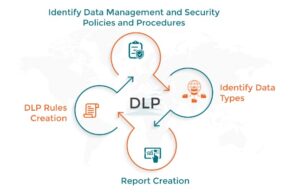
Effective DLP relies on clearly defined security policies.
Examples include:
- Block confidential files from personal email
- Prevent uploads to unauthorized cloud services
- Restrict external sharing
- Encrypt sensitive documents automatically
- Prevent printing of classified materials
Automation ensures consistent enforcement without relying entirely on manual oversight.
Regulatory Compliance
Many industries require strict protection of sensitive information.
DLP supports compliance with regulations involving:
- Personal data protection
- Financial reporting
- Healthcare privacy
- Intellectual property
- Confidential business information
Comprehensive audit logs also simplify regulatory reporting and investigations.
Employee Awareness and DLP
Technology alone cannot eliminate data loss.
Organizations should educate employees about:
- Data classification
- Secure sharing
- Email safety
- Cloud storage policies
- Reporting suspicious activity
- Acceptable use guidelines
Employees who understand security policies are less likely to trigger accidental violations.
Benefits of DLP Systems
Organizations implementing Data Loss Prevention typically achieve:
- Better intellectual property protection
- Reduced insider risk
- Improved regulatory compliance
- Stronger visibility into data movement
- Lower probability of accidental leaks
- Faster incident investigation
- Improved customer trust
DLP strengthens the overall cybersecurity strategy by protecting the organization’s most valuable digital assets.
Common DLP Implementation Challenges
Successful deployment requires careful planning.
Organizations often encounter challenges such as:
- Data classification complexity
- Legacy systems
- Employee resistance
- Excessive false positives
- Policy refinement
- Integration with existing infrastructure
A phased implementation combined with continuous policy optimization generally produces the best results.
Future Trends in Data Loss Prevention
DLP technology continues evolving alongside modern cyber threats.
Emerging developments include:
- AI-powered content classification
- Behavioral analytics
- Zero Trust integration
- Adaptive policy enforcement
- Cloud-native DLP platforms
- Automated risk scoring
- Real-time insider threat detection
These innovations enable organizations to respond more intelligently to increasingly sophisticated data protection challenges.
Best Practices for Implementing DLP
Organizations should follow several key principles when deploying Data Loss Prevention solutions:
- Classify sensitive information before applying policies.
- Implement the Principle of Least Privilege.
- Encrypt confidential files both in transit and at rest.
- Continuously monitor data movement across endpoints, networks, and cloud services.
- Integrate DLP with identity and access management systems.
- Regularly review and update security policies.
- Conduct employee awareness training.
- Audit DLP alerts and refine detection rules to minimize false positives.
A balanced approach combining technology, governance, and employee education delivers the most effective long-term protection.
Conclusion
In an era where intellectual property, customer information, and proprietary business knowledge represent some of an organization’s most valuable assets, preventing data loss has become a strategic necessity. Traditional security technologies remain important, but they are not designed to control how legitimate users handle sensitive information after gaining access.
Data Loss Prevention systems address this challenge by continuously identifying, monitoring, and protecting confidential data across endpoints, cloud platforms, email, collaboration tools, and corporate networks. Through advanced content analysis, policy enforcement, encryption, behavioral monitoring, and automated response capabilities, DLP solutions help organizations safeguard trade secrets, reduce insider threats, support regulatory compliance, and maintain customer trust.
As businesses continue embracing remote work, cloud computing, and digital collaboration in 2026, implementing a comprehensive DLP strategy is no longer optional—it is a critical component of modern cybersecurity and long-term business resilience.