Market Statistics, Average Financial Losses for Small and Medium-Sized Businesses, and AI-Driven Cyber Threat Predictions
Cybercrime has evolved into one of the world’s fastest-growing criminal industries, affecting organizations of every size and across every sector. What was once considered a problem primarily for large multinational corporations has become a daily reality for small and medium-sized businesses (SMBs), healthcare providers, manufacturers, educational institutions, financial organizations, and government agencies.
In 2025 and 2026, cyberattacks are no longer isolated incidents carried out by individual hackers. Instead, they are increasingly orchestrated by well-funded cybercriminal organizations, ransomware-as-a-service (RaaS) affiliates, nation-state actors, and highly organized cybercrime networks that operate much like legitimate businesses. These groups leverage automation, artificial intelligence (AI), cloud infrastructure, and sophisticated social engineering campaigns to maximize their financial returns while minimizing operational costs.
At the same time, organizations continue accelerating digital transformation. Hybrid work, cloud computing, SaaS applications, Internet of Things (IoT) devices, remote collaboration, and AI-powered business tools have significantly expanded the modern attack surface.
Understanding current cyber threat trends is no longer optional. Business leaders need actionable intelligence to identify which assets are most valuable to attackers, evaluate financial risks, and prioritize cybersecurity investments accordingly.
This article provides an overview of the cyber threat landscape in 2025–2026, examines the business assets most frequently targeted by attackers, discusses the financial impact of modern cyber incidents on small and medium-sized businesses, and explores how artificial intelligence is reshaping both cyberattacks and cyber defense.
The State of Cybercrime in 2025–2026
Cybercrime has become a mature global industry supported by underground marketplaces, ransomware affiliate programs, stolen credential exchanges, malware developers, and illicit cryptocurrency payment networks.
Modern cybercriminals increasingly specialize in specific stages of an attack, including:
- Initial network access
- Credential theft
- Malware development
- Data exfiltration
- Ransom negotiations
- Cryptocurrency laundering
This specialization has made cyberattacks more scalable, efficient, and profitable than ever before.
Why Small and Medium-Sized Businesses Are Prime Targets
Many business owners mistakenly believe attackers focus exclusively on large enterprises.
In reality, SMBs have become attractive targets because they often possess valuable customer data and financial information while operating with smaller cybersecurity budgets and fewer dedicated security professionals.
Common reasons attackers target SMBs include:
- Limited cybersecurity resources
- Outdated software
- Weak password practices
- Inadequate employee training
- Poor backup strategies
- Misconfigured cloud environments
- Limited security monitoring
Attackers frequently automate reconnaissance, allowing them to identify vulnerable organizations on a large scale.
Business Assets Most Frequently Targeted
Not all digital assets have equal value.
Cybercriminals prioritize information that can be monetized quickly or used to pressure organizations into paying ransom demands.
The most frequently targeted assets include:
Customer Databases
Customer information remains one of the most valuable digital assets.
Compromised databases may contain:
- Personal information
- Contact details
- Purchase histories
- Payment records
- Authentication credentials
Such data can be sold on underground marketplaces or used in identity theft campaigns.
Financial Information
Attackers actively seek access to:
- Banking credentials
- Accounting systems
- Payment platforms
- Payroll records
- Tax documentation
Financial information enables direct monetary theft and business fraud.
Intellectual Property
Organizations increasingly rely on proprietary knowledge to remain competitive.
High-value targets include:
- Source code
- Product designs
- Engineering documentation
- Manufacturing processes
- Research and development data
- Strategic business plans
The theft of intellectual property may cause long-term competitive disadvantages.
Employee Credentials
Compromised employee accounts often provide access to multiple corporate systems.
Attackers commonly target:
- Email accounts
- Cloud services
- VPN credentials
- Administrative accounts
- Collaboration platforms
Credential theft remains one of the most common entry points for cyberattacks.
Cloud Infrastructure
As organizations migrate to cloud environments, attackers increasingly focus on:
- Cloud storage
- SaaS applications
- Virtual machines
- Identity management systems
- API credentials
Misconfigured cloud services remain a leading cause of data exposure.
The Rise of Ransomware
Ransomware continues to dominate the cyber threat landscape.
Modern ransomware attacks frequently involve:
- Data encryption
- Data theft
- Double extortion
- Triple extortion
- Distributed Denial-of-Service (DDoS) threats
- Public disclosure campaigns
Organizations now face operational, financial, legal, and reputational consequences simultaneously.
Business Email Compromise (BEC)
Business Email Compromise remains one of the most financially damaging cyber threats.
Attackers impersonate:
- Executives
- Suppliers
- Financial institutions
- Human resources personnel
The objective is often to convince employees to:
- Transfer funds
- Change payment details
- Share confidential documents
- Reveal authentication credentials
Because these attacks rely on social engineering rather than malware, they are often difficult to detect.
The Financial Impact on Small and Medium-Sized Businesses
Cyber incidents affect organizations in multiple ways beyond immediate technical recovery.
Typical costs include:
- Business interruption
- Incident response
- System restoration
- Legal services
- Regulatory compliance
- Customer notification
- Public relations
- Cybersecurity improvements
For many small and medium-sized businesses, the total financial impact of a serious cyberattack can range from tens of thousands to several hundred thousand US dollars, while major ransomware incidents or prolonged operational disruptions can result in losses exceeding one million dollars when downtime, recovery expenses, legal obligations, and reputational damage are included. Actual losses vary significantly depending on industry, company size, the scope of the incident, and regulatory requirements.
Indirect costs—including lost customer confidence and missed business opportunities—may continue long after technical recovery is complete.
Why Downtime Is So Expensive
Every hour of operational disruption affects multiple business functions.
Downtime may interrupt:
- Customer service
- Manufacturing
- Logistics
- Sales
- Online transactions
- Internal communications
- Financial operations
For organizations operating around the clock, prolonged outages can quickly become one of the largest components of total cyber incident costs.
Artificial Intelligence Is Changing Cybercrime
Artificial Intelligence has become a powerful tool for both defenders and attackers.
Cybercriminals increasingly use AI to:
- Generate convincing phishing emails
- Automate malware development
- Analyze stolen data
- Identify vulnerabilities
- Conduct large-scale reconnaissance
- Create realistic voice impersonations
- Produce convincing fake documents
Automation allows attackers to target significantly more organizations than traditional manual techniques.
AI-Powered Social Engineering
Generative AI enables highly personalized attacks.
Instead of generic phishing messages, attackers can now create emails tailored to:
- Individual employees
- Executive leadership
- Business partners
- Customers
These messages often contain:
- Accurate company information
- Natural language
- Personalized references
- Contextually relevant requests
As a result, distinguishing fraudulent communications from legitimate business correspondence has become increasingly difficult.
Deepfakes and Executive Fraud
AI-generated voice and video technology has introduced new risks.
Attackers may attempt to impersonate executives during:
- Phone calls
- Video meetings
- Financial approvals
- Customer communications
Organizations should implement independent verification procedures for high-value financial transactions and sensitive business requests.
Supply Chain Attacks
Businesses increasingly depend on software vendors, cloud providers, managed service providers, and external contractors.
Compromising one trusted supplier may provide attackers with indirect access to multiple organizations simultaneously.
Vendor risk management has therefore become a critical cybersecurity priority.
Industries Facing the Highest Risk
Although every organization is a potential target, several industries experience elevated cyber risk.
These include:
- Healthcare
- Financial services
- Manufacturing
- Retail
- Education
- Government
- Professional services
- Technology companies
The combination of valuable data and operational dependence on digital systems makes these sectors particularly attractive to attackers.
How Businesses Can Reduce Risk
Organizations should adopt a layered cybersecurity strategy that includes:
- Multi-Factor Authentication (MFA)
- Zero Trust architecture
- Endpoint Detection and Response (EDR)
- Regular software updates
- Secure cloud configurations
- Employee awareness training
- Immutable backups
- Continuous security monitoring
- Incident response planning
Cyber resilience depends on combining technology, governance, and employee awareness.
Building a Cybersecurity Culture
Technology alone cannot prevent cyber incidents.
Employees should receive ongoing education covering:
- Phishing awareness
- Password management
- Secure remote work
- Data handling procedures
- Incident reporting
A security-conscious workforce significantly reduces organizational exposure to cyber threats.
Future Cyber Threat Predictions
Looking beyond 2026, several trends are expected to shape the cybersecurity landscape.
These include:
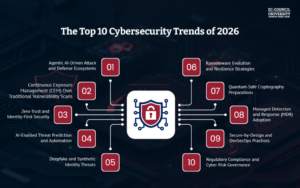
- Increased AI-driven attacks
- Greater use of autonomous malware
- More sophisticated ransomware campaigns
- Expansion of cloud-focused attacks
- Continued growth of supply chain compromises
- Advanced credential theft techniques
- Increased exploitation of connected devices
- More targeted attacks against small and medium-sized businesses
Organizations that continuously adapt their cybersecurity strategies will be better positioned to manage these evolving risks.
Key Priorities for Business Leaders
Executives and managers should focus on several strategic objectives:
- Identify critical business assets.
- Understand organizational cyber risks.
- Invest in employee education.
- Strengthen identity and access management.
- Develop tested incident response plans.
- Maintain secure backup and recovery capabilities.
- Continuously monitor emerging threats.
- Treat cybersecurity as an ongoing business investment rather than a one-time technology project.
Leadership commitment remains one of the strongest predictors of long-term cyber resilience.
Conclusion
The cyber threat landscape of 2025–2026 is defined by increasing sophistication, automation, and the growing influence of artificial intelligence. Cybercriminals are no longer interested solely in disrupting systems—they actively target customer databases, financial records, intellectual property, cloud environments, and employee identities because these assets provide direct financial value and leverage for extortion.
For small and medium-sized businesses, the consequences of a successful cyberattack extend far beyond immediate technical recovery, often resulting in significant operational downtime, financial losses, legal obligations, and long-term reputational damage. As AI enables increasingly personalized phishing campaigns, deepfake-based fraud, and automated attack techniques, organizations must adopt a proactive cybersecurity strategy built on Zero Trust principles, strong identity protection, continuous monitoring, employee education, resilient backup systems, and well-rehearsed incident response plans.
In 2026 and beyond, cybersecurity is no longer simply an IT concern—it is a core business discipline that directly influences operational resilience, customer trust, regulatory compliance, and long-term organizational success.